
In Evangelii Gaudium no.53., pope Francis stated that such an economy kills to highlight the destructive consequences of a capitalistic system driven solely by profit and the pursuit of wealth. He observed that in such a system, the relentless pursuit of profit often leads to inequalities, poverty, and social exclusion. The emphasis on market forces and the prioritization of financial gain over human dignity and well-being can result in the marginalization and exploitation of vulnerable individuals and communities. The relentless pursuit of economic growth and consumption can also have devastating effects on the environment, leading to environmental degradation, resource depletion, and climate change. By stating that such an economy kills, Pope Francis aimed to draw attention to the human suffering and social injustices perpetuated by a capitalistic system that prioritizes profit above all else. Through his encyclicals, the pope is trying to clearly indicate that the analysis and understanding of the economy itself cannot be carried out in a relevant and qualitative way only and exclusively from a narrow economic perspective or point of view. Behind such a narrow view of the economy lies the rejection of God (EG 57), which then, by removing objective norms and values, pulls everything into the logic of the market governed by the law of supply and demand (LS 123). And thus, essentially, the doors to relativism have been opened wide, which fits perfectly with an economic model that does not recognize permanent or objective values (such as the dignity of the human person), so the only acceptable dogma or objective reality becomes that which is defined solely by the market (FT 168).
This approach to the economy is short-sighted and highly unsustainable, not only harming individuals and societies by resulting in increased social inequalities but also endangering our common home. The technocratic capitalist paradigm (LS 109) being globally imposed deprives us of social, cultural, and ultimately, economic diversity, now threatening to redefine humanity through various forms of transhumanism. Technology is not neutral (LS 114). It is necessary to slow down, critically examine the situation and the direction of economic-technological progress, which proves unsustainable and detrimental, and boldly embark on the adventure of finding new, alternative approaches and models to global crises without unjustifiably neglecting the local context and environment.
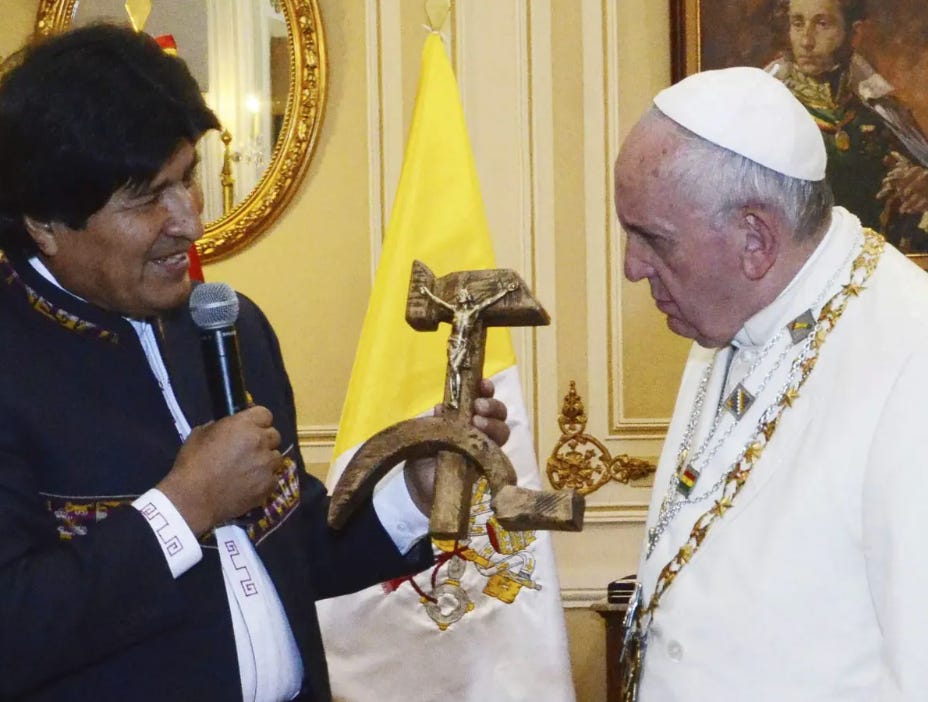
Such strong words and unequivocal criticism of capitalism as the prevailing global economic system, resonated throughout the world and resulted in almost unprecedented qualifications for a pope. On the one hand, these Pope’s words were received with enthusiasm and approval – primarily by the secular and, I would say, culturally left-wing part of the public, which for many years has been pointing out the shortcomings and problems that capitalism causes to society. On the other hand, many believers reacted extremely inappropriately, showing a high level of distrust in the Pope’s openness, dedication to dialogue and critical approach to capitalism. Conservative Catholics in USA, who are strong proponents of the free market and capitalism, were especially vocal, and they accused the Pope of not understanding the economy, statistics and data that are available. The Pope was accused of being a communist, socialist and a Marxist – simply because he wanted and wants to establish a dialogue with all people of good will so that we can achieve the common good together.
When you add to that certain papal decisions (for example, the decision that divorced Catholics who are civilly married can receive communion as AL 305 says, the decision to bless same-sex couples, the decision to limit access to the TLM and to initiate the synodal process of the universal Church which includes some “tricky” theological questions), all this, along with many other papal moves and decisions, has led to the theological question of discontinuity between Pope Francis and his predecessors. The catholicity of the Catholic Church was called into question. Therefore, many rushed to declare the pope a heretic, an antipope, and as we now see, some were excommunicated because of it.
My idea, which I will present precisely on the issue of this possible discontinuity within Catholic social teaching when it comes to economic topics, is that this is not an essential discontinuity at all, or a discontinuity that would be dogmatically or doctrinally marked. On the contrary, it is only a phenomenological discontinuity that is a consequence of the personality, spontaneity and life experience of Pope Francis. This discontinuity, a phenomenological discontinuity, does not represent a discontinuity in Doctrine or Dogma of the Church, but is a consequence of the Pope’s lifestyle, behavior and management of the Church. It is the expression of aggiornamento, a need for the change of perspective and an effort for the Church to open up and fully accept the pastoral turn of the Second Vatican Council.
And when all these questions about possible discontinuity are approached calmly and without the heated passion that is perhaps appropriate for the cultural battles that we wage over civilizational values in our Western society, then such final judgments can by no means be justified and grounded in theological reality. And this can be seen most clearly in the Pope’s criticism of capitalism.
It is interesting to note here that the Catholic social teaching was more clearly articulated and explicitly acknowledged by the Church, thanks precisely to the economy and the economic issues and problems of human labor at the end of the 19th century. The first social encyclical, which speaks of the new (we could say, capitalist) economic (industrial) context within which it particularly observes the value and social role, as well as the meaning of human labor and even the beginnings of drastic social inequality that will mark the world we live in, clearly sets the guidelines and principles of the entire content of the Catholic social teaching. And at the beginning of CST we have a rather harsh words from the Pope that speaks to defraud any one of wages that are his due is a great crime which cries to the avenging anger of Heaven. The Church rightly speaks about new things and in this way offers, primarily to the faithful but also to all people of good will, a supernatural view of the nature and meaning of man, society, and the world as a whole. As Chesterton wrote long ago in Orthodoxy, only the supernatural has a sane view of nature, and thus the Church – as the Mystical Body of Christ – sees more clearly, better, and more competently these worldly and social events and processes, understanding them in the light of Revelation and the Gospel, discerning the signs of the times as she is called to do until the end of the world. In this way, the Church serves humanity, with which it walks the paths of history. “In her social doctrine the Church offers above all an integral vision of man and a complete understanding of his personal and social dimensions.” (Compendium 522) And that is precisely what is lacking in the modern world and in man – a comprehensive and complete understanding of oneself. A knowledge of God is a prerequisite for a knowledge of man as he really is, in all his fullness.
In that context, it is especially important to emphasize the Church’s constant insistence on the essential interconnectedness of all spheres of society (whether vertically in relation to the local-global, which represents subsidiarity, or horizontally in relation to the question of who is my neighbor, which represents solidarity), and the necessity of recognizing and respecting the integrity of the human person, as well as humanity as a whole, articulated through insistence on the common good. These three principles (the common good, subsidiarity, and solidarity) are indeed the foundations of the entire Catholic social teaching, which themselves arise from the obligation toward the inalienable dignity of every human being. Thus, spanning from the inception of Catholic social teaching to the era of pope Francis, whenever the Church addresses economic relations, processes, and the economic domain of society, it consistently advocates for all three principles to be upheld, ensuring that the economy fulfills its primary purpose: serving the welfare of humanity.
Therefore, criticisms directed towards the Pope (primarily aimed at justifying contemporary global capitalism by labeling pope Francis a socialist) must simultaneously be directed at the entire Church and all his predecessors who, through the clear articulation of Catholic social teaching, have positioned the Church regarding her stance on the economy and everything that it entails. Thus, the Church’s position cannot be labeled as either capitalist (in the sense of the prevailing capitalism today) or socialist, but rather as the rightful position of the Church which, through a supernatural perspective, sees and understands the nature of humanity and the nature of human society (hence economy). Catholic social teaching, as it gradually developed, became an important model between radical liberalism (capitalism) and the Marxist theory of the State. Throughout this progression and development, Catholic social teaching has consistently emphasized the dignity of the human person, the common good, solidarity, subsidiarity, and the preferential option for the poor as guiding principles for building a more just and humane economy.
The Compendium is completely in accordance with pope Francis (and vice versa) when stating that the free market cannot be judged apart from the ends that it seeks to accomplish and from the values that it transmits on a societal level. The individual profit of an economic enterprise, although legitimate, must never become the sole objective. And also that goods, even when legitimately owned, always have a universal destination; any type of improper accumulation is immoral, because it openly contradicts the universal destination assigned to all goods by the Creator.
Pope John Paul II in almost every social encyclical emphasized that even though the free market is the most efficient instrument for utilizing resources and effectively responding to needs. But there are many human needs which find no place on the market. There are goods which by their very nature cannot and must not be bought or sold. Certainly, the interest and logic of the market are not in themselves sufficient criteria for economic choices. The pope clearly states that the Church’s social doctrine adopts a critical attitude towards both liberal capitalism and Marxist collectivism and that capitalism should not be the model for the countries of the Third World.
Pope Benedict 16th also strongly criticized the capitalism and free market stating that the market is not, and must not become, the place where the strong subdue the weak. It is a place of exchange, not only of goods but also of mutual assistance and service. Pope also reminds us that economic activity cannot solve all social problems through the simple application of commercial logic.
And then we have Pope Francis who is criticized for saying that such an economy kills.
But in that case, the pope does not say anything new or different from his predecessors, but only speaks more explicitly and directly. If we remember, from the very beginning of his pontificate, the silver cross, the change of the apartment in which he lives, to the almost complete spontaneity in interviews and dealing with people, Pope Francis has now accustomed us to a different papacy, a different and more relaxed style. And that is exactly what his entire pontificate is like. The Pope is quite spontaneous and free in his actions, whether it is an official document or informal socializing or recording television interviews. He wants to be close to the people and the times in which we live and in which he carries out his mission – personally, but also the Church. This sometimes leads to misunderstandings, so the pope has to justify himself, but this also shows that there are more and more believers who do not approach the pope’s spontaneity and freedom in good faith. And in my opinion, this indicates a crisis of faith, which I don’t have time to talk about here.
Overall, Pope Francis’s attitude towards capitalism is one of critical engagement and constructive dialogue. While acknowledging the positive aspects of capitalism, such as innovation and entrepreneurship, he calls for a more just and equitable economic system that prioritizes the needs of all people, especially the poor and vulnerable, and promotes the integral well-being of humanity and the planet. Therefore, no discontinuity can’t be found within Catholic social teaching, except this phenomenological discontinuity that is a consequence of pope Francis’s personality and leadership.
 Adekvatna Teologija | Bruno Petrušić